With modern AI tools, building software has never been more accessible.
That can make an in-house booking system sound surprisingly simple:
Why keep paying for booking software when we can just build our own?
For some businesses, building custom software can absolutely make sense. But there is an important distinction between building a booking system and owning and operating one for the next five or ten years.
The first part has gotten much easier.
The second part hasn’t.
There’s no question that AI coding tools have changed software development.
A capable developer can create interfaces, databases, booking flows, integrations, and other functionality much faster than was possible even a few years ago.
A basic reservation calendar may not be particularly difficult to build.
But getting the first version working is only the beginning.
Once customers depend on that software to make reservations, purchase memberships, make payments, redeem credits, or access your facility, someone has to make sure it continues working every day.
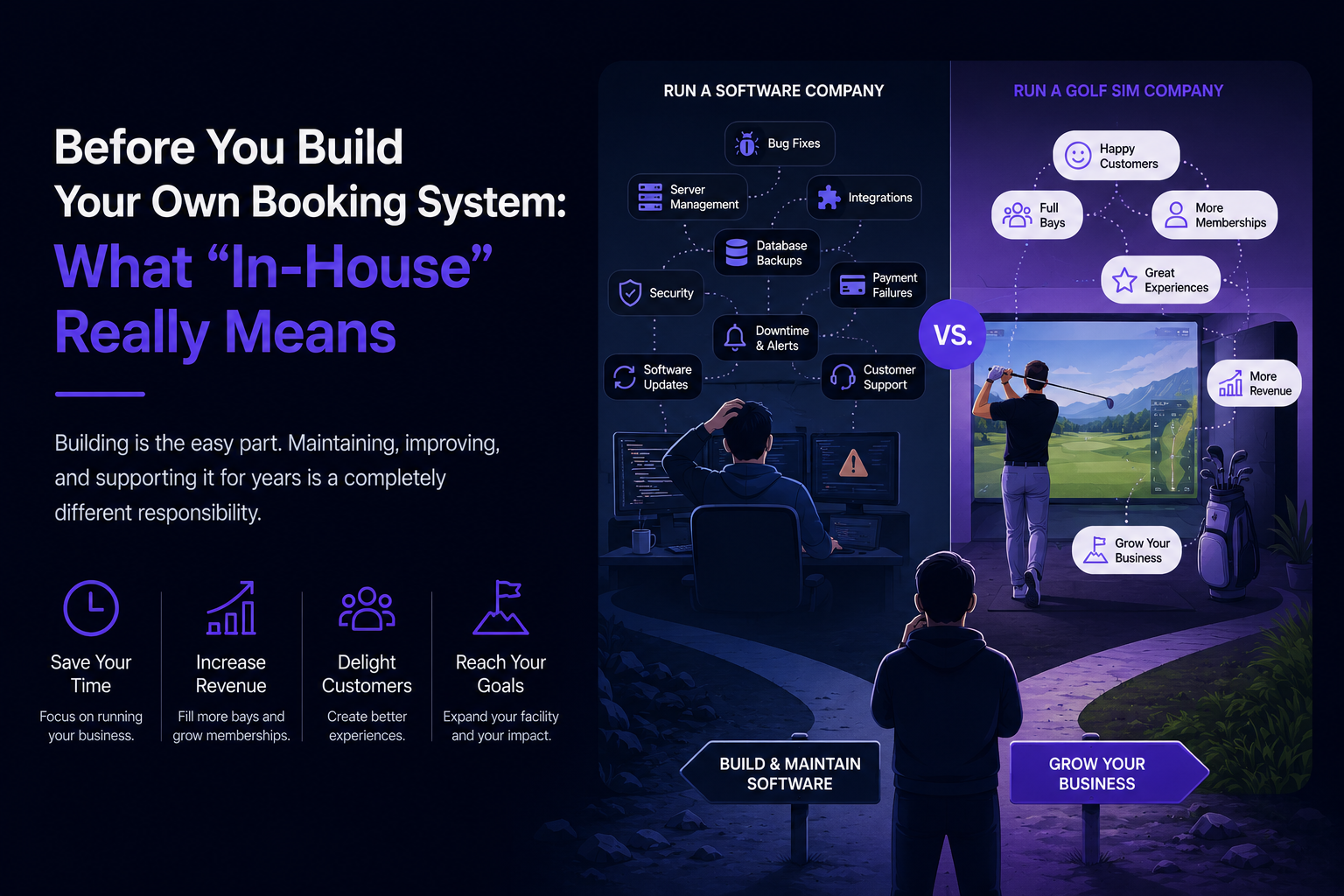
That means maintaining the application, hosting, databases, backups, security, payments, integrations, notifications, monitoring, and everything else happening behind the scenes.
And that work never really stops.
Most reservation systems look relatively simple from the outside.
Pick a date. Pick a time. Pick a bay. Pay. Done.
The complexity is everything surrounding that reservation.
What happens when two customers try to reserve the same bay at the same time?
What happens when a membership renewal payment fails?
What happens when pricing changes depending on the time of day, membership, promotion, or holiday?
Those are just a few examples.
Then add refunds, taxes, credits, gift cards, loyalty, promo codes, cards on file, recurring billing, multi-bay reservations, customer notifications, access control, reporting, and integrations with other systems.
None of these problems necessarily makes a booking platform impossible to build.
The challenge is the sheer number of scenarios that emerge once thousands of real customers start using it.
The first version is usually the easy part. Years of real-world usage are what turn software into a mature product.
This is where the economics of an in-house system can start to look different.
Software doesn't stay finished.
Browsers change. Phones change. Payment platforms change. APIs change. Hardware changes. Security requirements change. Your own business changes.
Someone has to keep up with all of it.
That includes ongoing:
Maintenance
Bugs need to be fixed, dependencies updated, databases maintained, and software kept compatible with the technology around it.
Infrastructure
Servers, databases, backups, monitoring, alerts, performance, and recovery systems all need to operate reliably.
Integrations
Payment platforms, access control, launch monitors, calendars, messaging providers, and other systems evolve independently. Your integrations need to evolve with them.
Improvements
Your business will eventually want something the original system doesn't do. Someone has to design, build, test, deploy, and maintain that functionality.
Support
When something goes wrong while customers are trying to reserve or pay, someone needs to investigate it.
The cost of an in-house platform isn't simply what it costs to create version one.
It's what it costs to keep version 37 working years later.
That can work.
But at that point, you've effectively decided to operate a small software company inside your golf business.
Someone needs to understand the application, database, infrastructure, payments, integrations, deployments, and business logic.
You also need continuity.
What happens if the person who built it eventually leaves or becomes unavailable? Can another developer understand the system? Is it documented? Who handles an issue when the original developer isn't around?
A booking system eventually becomes critical infrastructure.
If reservations stop working, you aren't dealing with an inconvenient website bug. You're potentially dealing with customers who can't spend money with your business.
That requires a different level of responsibility.
This is one of the easiest things to overlook when comparing building versus buying.
When you pay for an established software platform, you aren't simply paying for the features currently visible on the screen.
You're paying for the system to continue working tomorrow.
You're paying for maintenance, infrastructure, monitoring, security, integrations, bug fixes, improvements, support, and continued product development.
You're also paying for something that's much harder to recreate:
Everything that has already been learned.
Many features in mature software exist because a business encountered a problem years ago.
Certain rules exist because an edge case appeared.
Automations exist because operators repeatedly found themselves doing something manually.
Those lessons accumulate over thousands or millions of customer interactions.
You don't necessarily see that history when looking at the finished product, but it's part of what you're buying.
There is another advantage to using software built specifically for an industry.
Your business isn't the only one helping shape the product.
When hundreds of golf facilities use the same platform, problems and ideas discovered by one operator can eventually benefit everyone.
One facility encounters an unusual membership scenario. Another finds a better way to manage peak pricing. Another needs an integration. Another discovers an operational problem that hasn't occurred at your facility yet.
The platform learns from all of them.
An in-house system learns from one business. An industry platform can learn from hundreds.
That collective experience can be difficult to put a dollar value on, but it can be one of the biggest advantages of buying rather than building.
There is also the time required to own software.
Every hour spent managing developers, reviewing bugs, testing updates, troubleshooting integrations, or deciding how a technical feature should work is an hour that isn't being spent running your golf business.
That time could instead be spent increasing simulator utilization, selling memberships, improving pricing, running leagues and events, improving the customer experience, training employees, marketing the facility, or opening another location.
For most operators, the goal isn't to own booking software.
The goal is to operate a successful golf business.
Software should make that easier, not become another business you have to manage.
If you're considering building in-house, don't compare:
The cost of Birrdi vs. the cost to build version one.
That's not an apples-to-apples comparison.
Instead, think about:
Development + infrastructure + maintenance + monitoring + integrations + support + future development + your time
Then consider that cost over five or ten years.
You may still decide that building makes sense.
But now you're comparing the actual responsibilities of the two options rather than comparing a recurring software expense against a one-time development quote.
There are absolutely businesses where owning the technology is the right decision.
Typically, those businesses have highly specialized requirements that existing platforms cannot support, dedicated software engineers, engineering leadership, a meaningful technology budget, and enough scale that owning the technology creates a strategic advantage.
At that point, proprietary software may become part of the company's competitive advantage.
But that's very different from having someone build a replacement booking system simply because AI has made development faster and cheaper.
Being able to build something doesn't automatically mean owning it is the better business decision.
Modern AI has changed the answer to:
“Can we build our own booking system?”
For many businesses, the answer may very well be yes.
The better question is:
“Do we want to maintain, secure, support, integrate, troubleshoot, and continuously improve our own booking platform for the next five or ten years?”
That's a very different decision.
Birrdi exists so golf simulator operators don't also have to become software companies.
We maintain and improve the infrastructure behind reservations, payments, memberships, credits, automation, integrations, customer management, and the countless edge cases that emerge as facilities operate every day.
And because Birrdi serves the golf simulator industry, improvements made for one operator can ultimately make the platform better for everyone.
That's a large part of what you're paying for.
Not just the software that exists today, but the responsibility of keeping it working and improving tomorrow.
If you're considering moving to an in-house system, don't simply ask how quickly or cheaply the first version can be built.
Ask who will still be maintaining it five years from now, what that will actually cost, and whether owning a software platform is where you want to spend your time.
Because ultimately, your goal isn't to build a booking system.
It's to build a successful golf business.